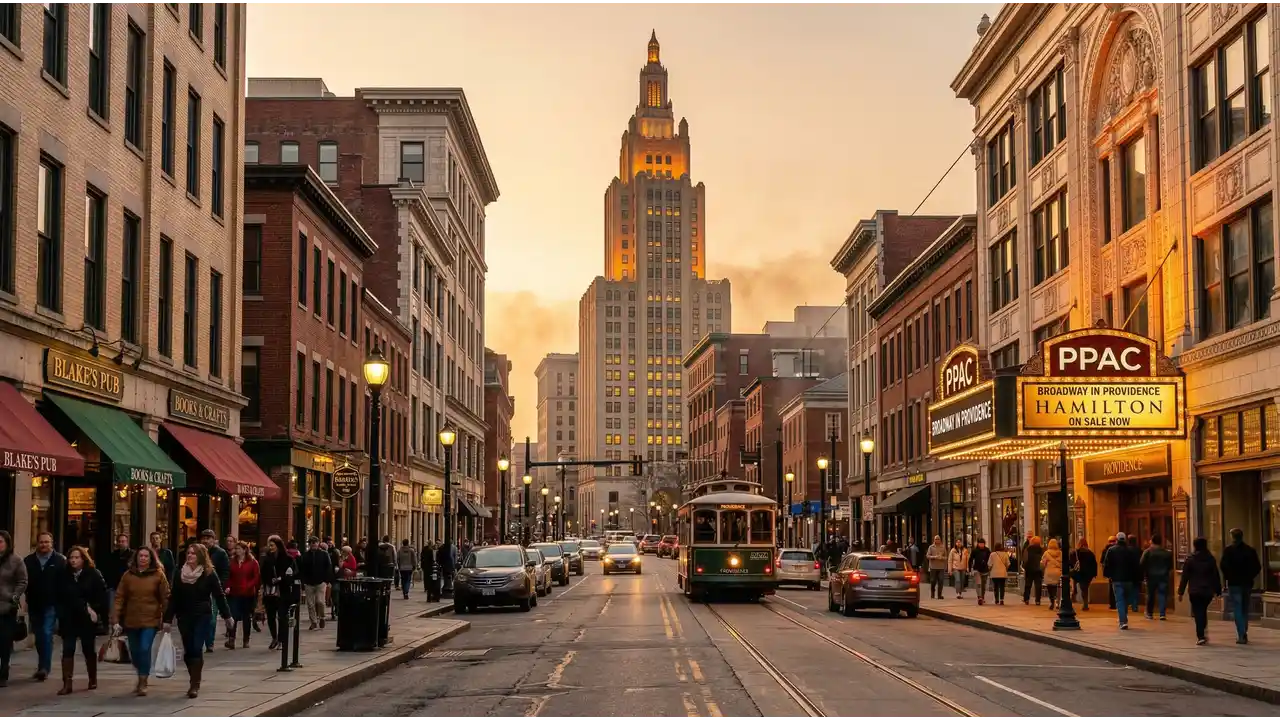
Providence is Rhode Island's capital and largest city, home to about 190,000 people. It sits on Narragansett Bay and functions as a regional hub for healthcare, education, and arts. Brown University and RISD anchor the city's character. Winters are cold and wet, summers mild. The downtown has seen investment in recent years, though neighborhoods vary widely in condition and character. Daily life centers on Federal Hill (Italian dining and shops), the arts district, and the waterfront. Public transit exists but is limited; most residents use cars.
💡 Local Insights
Providence · 2026
Providence offers lower costs than Boston or New York while maintaining urban density and cultural options. Housing dominates the budget at $2,215/month, which reflects a mix of older triple-deckers, converted industrial buildings, and newer apartments. Neighborhoods like Federal Hill and the East Side command higher rents ($1,400-$1,800 for a one-bedroom), while areas like Elmwood or North Providence run $1,000-$1,300. Grocery costs align with regional patterns at $552/month for moderate spending, with slight savings in chain stores versus specialty shops. Transportation is affordable; RIPTA bus passes cost around $65/month, and parking outside downtown is cheap. Food inflation has been steady but modest. Expats and remote workers often find Providence's proximity to Boston valuable without the Boston price tag. The biggest variable is neighborhood stability, so pick carefully before committing.
Frequently Asked Questions
How much does it cost to live in Providence per month?
A moderate lifestyle costs $3,925/month. This includes housing at $2,215/month, groceries at $552/month, utilities around $200/month, transport roughly $80/month, and discretionary spending of about $880/month for dining out, entertainment, and personal care. A budget tier lifestyle runs $2,355/month if you minimize dining out and live in cheaper neighborhoods. A comfortable lifestyle with more flexibility costs $6,084/month, allowing for better housing and regular restaurant visits.
What is the average rent in Providence?
Average rent aligns with $2,215/month for a typical one-bedroom apartment. Specific neighborhoods vary: East Side and Federal Hill, the most desired areas, run $1,400-$1,800 for a one-bedroom. College Hill near Brown University sits $1,200-$1,600. Elmwood, Mount Pleasant, and North Providence offer one-bedrooms at $1,000-$1,300. Two-bedroom apartments typically range $1,500-$2,200 across the city. Older buildings are common, so inspect for heating efficiency and plumbing. Most leases require first month, last month, and security deposit upfront.
Is Providence cheap to live in for expats?
Providence is moderately priced for expats accustomed to major US cities. Compared to Boston (roughly 35-40% higher), New York (60% higher), or San Francisco (80% higher), Providence is genuinely affordable. Compared to mid-size Midwest cities, it's slightly expensive. For expats from Western Europe, Providence feels cheap; for expats from Latin America or Asia, it's moderate. The real advantage is access to urban services at lower cost. Healthcare is good due to Brown University and hospital infrastructure. The downside is limited public transit, so budget for a car or rideshare if you don't live downtown.
How much does food cost per month in Providence?
Groceries run $552/month for one person on a moderate budget. This covers basic cooking at home with eggs around $4/dozen, milk $4/gallon, chicken $8-$10/pound, and fresh produce varying by season. Trader Joe's and Stop and Shop are common chains. Federal Hill has specialty Italian grocers with higher prices. Dining out averages $15-$25 for casual meals, $40-$70 for mid-range restaurants. Coffee runs $3-$5. Alcohol is moderately priced; beer $6-$8 per six-pack, wine $12-$20 per bottle in shops.
What salary do you need to live comfortably in Providence?
A comfortable lifestyle requires roughly $6,084/month, or about $73,000/year before tax. This allows for a nicer one-bedroom or modest two-bedroom in a good neighborhood, regular restaurant visits, entertainment, and some savings. In practice, a $75,000-$80,000 gross annual salary covers this with room for unexpected costs. If you have dependents or want to save significantly, aim for $90,000+. Remote workers earning US salaries find this threshold quite achievable. Local median household income is around $48,000, so comfortable expat living sits well above local norms.
How does the cost of living in Providence compare to other places?
Providence sits in the middle range for US cities. A moderate lifestyle costs $3,925 per month here, with housing running $2,215 monthly.
You'll find Providence notably cheaper than San Francisco, where a moderate lifestyle reaches $5,200 per month and housing alone costs $3,302. Compared to peer cities, Portland comes in lower at $3,325 for a moderate lifestyle, though its housing at $1,590 is also less expensive than Providence's. Norfolk offers the steepest savings of these comparisons, with a moderate lifestyle at $2,650 and housing at $1,051 monthly.
Providence's appeal largely centers on that housing cost relative to other established Northeast cities. For someone relocating from a major coastal metro, the difference can be substantial. Local incomes tend to be lower than national averages, though, so actual affordability depends on your job prospects here.
Yes, but with real constraints. This budget supports housing around $1,200-$1,400/month in less central neighborhoods like Elmwood or North Providence, plus $400-$450 for groceries and basics. You'll need to cook most meals, use public transit exclusively, and avoid dining out or entertainment spending. Utilities and phone consume another $120-$150. This leaves almost nothing for emergencies, medical costs, or one-time expenses. It's livable if you have nearby support (family, partner with income), secure employment, and good health. Remote workers and graduate students sometimes manage this; others find it too tight. Consider $2,800+ as a safer minimum for independent living.