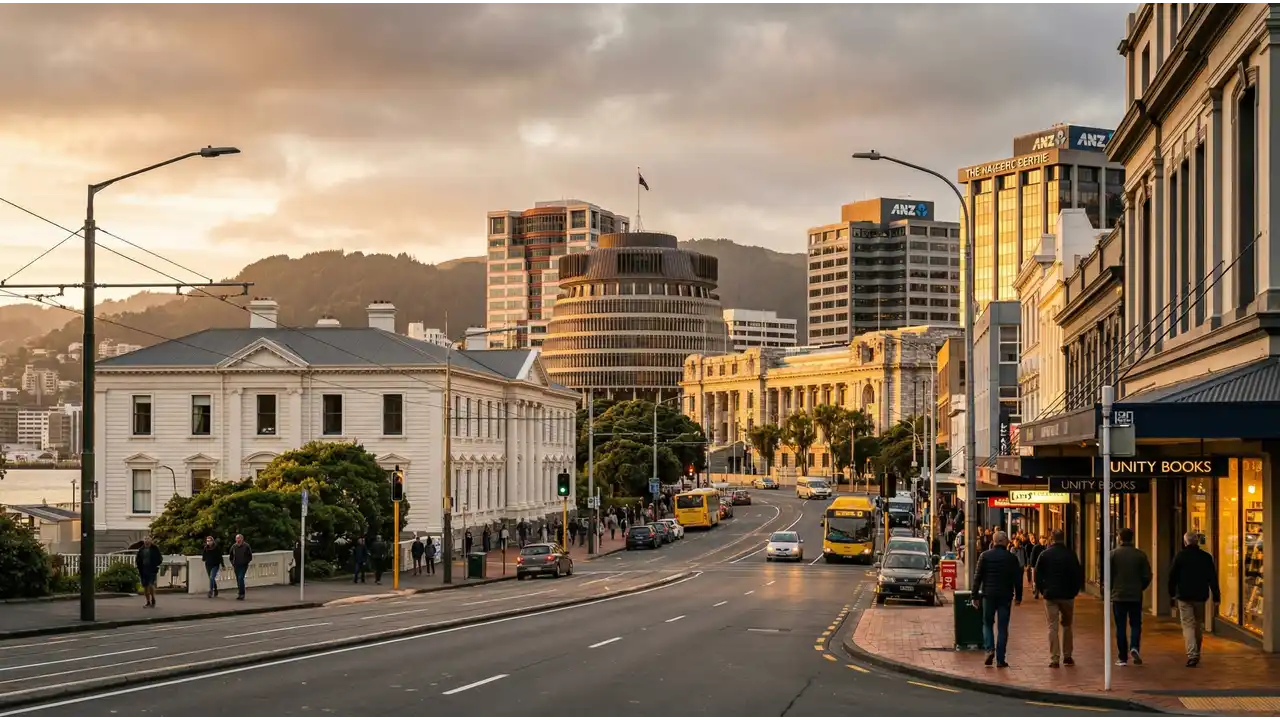
Hamilton is a city of around 170,000 people in the Waikato region, about two hours south of Auckland. It sits on the Waikato River and serves as a regional hub for agriculture, education, and manufacturing. The climate is temperate with distinct seasons; winters are mild but wet, summers warm. Daily life revolves around car travel, though the city center is walkable. It attracts families, students (Waikato University), and rural workers. Housing is notably cheaper than Auckland. Schools, healthcare, and shopping are readily available. The pace is slower than major metros, with strong community ties.
💡 Local Insights
Hamilton NZ · 2026
Hamilton costs less than Auckland and Wellington, but more than smaller provincial towns. The moderate lifestyle budget of $2,500/month reflects realistic local spending. Housing costs $1,074/month according to the New Zealand national figure that Hamilton inherits; this is not a separately measured local rent rate. In practice, renters find one-bedroom apartments in central suburbs like Frankton or Claudelands ranging from $850 to $1,100 monthly, while homes further out run lower. Groceries cost around $460/month for a household; supermarket chains like Countdown and New World dominate. Transport is car-dependent, though regional buses operate; petrol prices track global rates. Eating out is cheaper than Auckland, with casual meals $12 to $18. Expats find no price discrimination in retail or housing, though visa sponsorship may limit job options. Water, rates, and utilities add $200 to $300 monthly depending on property size. Income tax and ACC levies are standard across New Zealand.
Frequently Asked Questions
How much does it cost to live in Hamilton NZ per month?
A moderate lifestyle in Hamilton costs $2,500/month. This breaks down roughly as: housing $1,074, groceries $460, transport $200 to $250, utilities and services $250 to $300, and discretionary spending $400 to $500. The budget tier is $1,500/month (minimal housing, shared accommodation, limited dining out, public transport). The comfortable tier is $3,875/month (private rental, eating out regularly, car ownership, entertainment). Individual circumstances vary widely; families with children and single renters face different priorities.
What is the average rent in Hamilton NZ?
Hamilton inherits the New Zealand national housing figure of $1,074/month rather than having a separate local measurement. In practice, Hamilton renters report one-bedroom apartments in popular suburbs like Frankton, Claudelands, or the City Centre running $850 to $1,100 monthly. Larger properties or those further from the city center cost less. Flatsharing (common among students and young workers) ranges $400 to $700 per room. The rental market is competitive but slower than Auckland; landlords typically require references, income verification, and a bond equal to four weeks' rent. Long-term leases (12 months) are standard.
Is Hamilton NZ cheap to live in for expats?
Hamilton is cheaper than Auckland, Wellington, and Christchurch, making it attractive for expats on modest incomes. However, it is not cheap by global standards. Rent, groceries, and utilities are significantly higher than Southeast Asia, India, or Latin America. Compared to London, Sydney, or Toronto, Hamilton offers real savings, particularly in housing. Expats face no price markup in shops or rentals, but visa restrictions may limit job options and earning potential. New Zealand's geographic isolation means imported goods cost more. Quality of life, safety, and healthcare access offset higher costs for many expats choosing provincial relocation over major cities.
How much does food cost per month in Hamilton NZ?
Groceries for a household average $460/month. A loaf of bread costs around $2.50 to $3.50, milk $2 to $2.50 per liter, chicken $10 to $14 per kilogram, and apples $3 to $5 per kilogram depending on season. Countdown and New World supermarkets set prices; budget chains like Pak'nSave offer modest savings. Eating out is cheaper than Auckland: coffee $4 to $5, casual lunch $12 to $18, dinner $25 to $40 at mid-range restaurants. Farmers' markets and local orchards around Waikato offer seasonal produce at lower cost. Imported goods (European cheese, specialty items) are notably expensive.
What salary do you need to live comfortably in Hamilton NZ?
The comfortable tier is $3,875/month, suggesting a gross annual income of around $62,000 to $65,000 NZD (accounting for income tax and ACC levies). This supports private rental, regular dining out, car ownership, and entertainment without budget stress. For couples, combined household income of $75,000 to $85,000 NZD provides more flexibility. New Zealand income tax is progressive; at $65,000 gross, take-home is roughly $50,000 to $52,000 annually after tax and levies. Employment contracts often specify hourly rates or annual salaries; minimum wage is $23.15 NZD/hour. Freelancers and contractors should budget for self-employed tax obligations.
How does the cost of living in Hamilton NZ compare to other places?
Hamilton sits in the middle of New Zealand's cost-of-living spectrum. A moderate lifestyle here runs $2,500 per month, with housing at $1,074. That makes it slightly cheaper than Perth, where the same lifestyle costs $2,625 monthly with housing at $1,435. Christchurch offers the best value if you're staying in New Zealand, running $2,050 for a moderate lifestyle and $1,050 for housing. On the dearer end, Darwin costs $2,900 monthly overall and $1,476 for housing. Compared to Australian cities, Hamilton remains relatively affordable, though you're paying developed-world prices. If you're relocating from more expensive regions, you'll notice genuine savings. Coming from cheaper areas, expect to adjust your budget upward, particularly for rental accommodation.
Yes, but with significant constraints. The budget tier is $1,500/month. This requires shared accommodation (flatsharing at $400 to $500/month), minimal discretionary spending, relying on supermarket groceries ($350 to $400/month), using buses instead of a car, and avoiding dining out. It cuts entertainment, travel, and savings. Single professionals might manage it; families cannot. International students on this budget commonly flatshare in student suburbs like Frankton. The lifestyle is viable but tight. Any unexpected cost (car repair, medical visit, visa fee) creates hardship. Moving to a regional town further south (Cambridge, Te Awamutu) could lower housing to $600 to $750/month, easing pressure significantly.