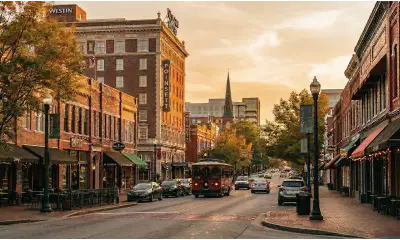
Columbia, South Carolina's capital, is a mid-sized city of about 137,000 people in the Midlands region. The climate is humid subtropical with hot summers and mild winters. The downtown area has seen renewal in recent years with riverfront development along the Congaree River. Daily life centers on Five Points (student and young professional neighborhood), the Vista arts district, and the State House grounds. The city draws state government workers, University of South Carolina students, and people seeking lower costs than coastal alternatives. Traffic is manageable compared to larger metros. The pace is steady rather than frantic.
💡 Local Insights
Columbia · 2026
Columbia's cost structure reflects a mid-tier American city with below-average housing and food costs. Housing at $1,120/month buys a one-bedroom apartment in central neighborhoods like Five Points or Shandon, or a shared house in outer areas. Detached rentals run slightly higher. Mortgage payments on modest homes are competitive. Grocery costs at $502/month reflect Southern food prices and local supermarket competition (Food Lion, Harris Teeter, Publix operate here). Eating out is cheap by national standards. Public transit exists but is limited; a car is practically essential for daily life. Property taxes are moderate. Utilities run higher in summer (air conditioning) and lower in winter. Expats often find Columbia affordable compared to Northeast or West Coast cities, though not as cheap as rural South Carolina. Local wages are lower than national averages, so negotiate carefully if relocating for work.
Frequently Asked Questions
How much does it cost to live in Columbia per month?
A moderate lifestyle costs $2,675/month. That breaks down to $1,120/month for housing (one-bedroom apartment or shared house), $502/month for groceries, plus utilities (roughly $120-180/month depending on season), transportation ($60-120/month if using transit or sharing costs), and discretionary spending on dining, entertainment, and personal care. On a tighter budget, $1,605/month is possible by sharing housing and cooking most meals. A comfortable lifestyle with dining out, entertainment, and more space runs $4,146/month.
What is the average rent in Columbia?
Expect $1,120/month for a one-bedroom apartment in walkable neighborhoods like Five Points, Shandon, or Forest Acres. Two-bedroom apartments run $1,300-1,500/month in those same areas. Shared housing (rooms in a house) costs $500-700/month. Detached house rentals range from $1,200-1,600/month for 2-3 bedrooms. Outer neighborhoods and newer suburbs offer slightly better rates. Downtown and riverfront units command a premium. These figures are consistent with moderate lifestyle housing costs in the city.
Is Columbia cheap to live in for expats?
Yes, compared to coastal US cities and most Western European capitals. Housing and groceries cost significantly less than Northeast or California locations. For expats from high-cost metros (London, Sydney, Toronto), Columbia feels affordable. However, you need a car, which adds expense. Salaries for English-teaching or service work are lower than major cities. Expats accustomed to walkable public transit should adjust expectations. The trade-off is real savings on rent and food against limited transit and fewer high-end amenities. Most expats report positive experiences on budgets around $2,200-2,800/month.
How much does food cost per month in Columbia?
Groceries average $502/month for one person eating mostly at home. A typical weekly shop might include chicken ($8-12/lb), ground beef ($5-7/lb), eggs ($3-4/dozen), milk ($3-4/gallon), bread ($2.50-3.50), fresh produce ($2-5 per item depending on season), and rice or pasta ($1-2/lb). Eating out is cheap: fast casual meals run $8-12, casual dinners $12-18. A mid-range restaurant costs $15-25 per person. Alcohol from stores is less taxed than in license states; beer is $6-8 per six-pack. Shopping at Food Lion or Walmart saves money versus specialty stores.
What salary do you need to live comfortably in Columbia?
A comfortable lifestyle costs $4,146/month, suggesting a gross monthly income of $5,500-6,000 (accounting for taxes and benefits). That's roughly $66,000-72,000/year before taxes. This budget allows for a larger apartment or modest house, regular dining out, entertainment, hobbies, and savings. Many Columbia residents working in state government, education, or mid-level corporate roles earn this range. Those working remotely for out-of-state employers on higher salaries find Columbia exceptionally affordable and can save significantly.
How does the cost of living in Columbia compare to other places?
Columbia sits in the middle of the cost spectrum. A moderate lifestyle here runs $2,675 per month, with housing at $1,120 per month. That puts it slightly cheaper than Fort Worth, where a moderate lifestyle costs $2,775 monthly and housing runs $1,240. If you're coming from a major East Coast city, you'll notice the difference. Alexandria runs $3,500 for a moderate lifestyle, making it roughly 30 percent more expensive than Columbia. On the flip side, Columbia costs significantly more than smaller European cities. Leipzig, for comparison, runs $1,825 monthly with housing at just $701. So Columbia is genuinely affordable by U.S. standards, particularly if you're relocating from a coastal metro area, but still substantially pricier than most international alternatives.
Yes, but with constraints. This budget tier requires shared housing ($500-650/month), cooking nearly all meals, minimal dining out, no car payment (use transit, walking, or carpooling), and limited entertainment spending. You lose flexibility on neighborhoods and must accept longer commutes or higher transit dependence. This works for students, remote workers saving aggressively, or those with significant outside support. It cuts out regular car use, gym memberships, and spontaneous purchases. Realistic for a modest lifestyle, tight for most people long-term.