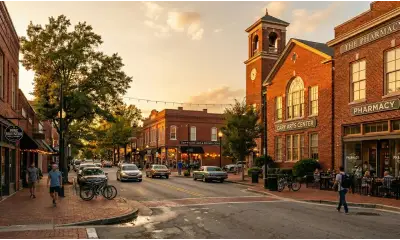
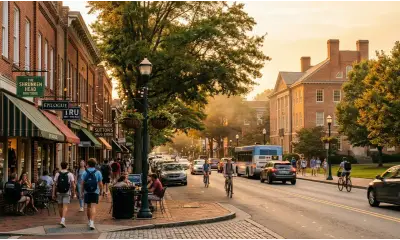
Raleigh is North Carolina's capital and the largest city in the Research Triangle region. The population has grown steadily over the past two decades, driven by tech companies, universities, and relatively affordable housing compared to major coastal metros. The climate is humid subtropical with hot summers and mild winters. Daily life centers on tech campuses, local restaurants, and outdoor recreation along the Neuse River. Most residents drive, though bike infrastructure and bus transit (Capital Area Transit System) have expanded. The city appeals to young professionals, families relocating from pricier metros, and people seeking moderate pace with access to culture and employment.
💡 Local Insights
Raleigh NC · 2026
Raleigh's cost structure reflects a growing tech hub that remains cheaper than comparable cities. Housing dominates the budget at $1,317/month, covering a range from $900 to $1,700 depending on location and property type. Downtown apartments and neighborhoods like Moore Square rent higher; outer areas and roommate situations cost less. Groceries run $511/month for a household shopping at standard supermarkets like Harris Teeter or Food Lion. Restaurant meals cost 20-30 percent more than groceries. Transit costs roughly $50-100/month if you drive, or $40/month for a CATS bus pass. Car ownership is standard due to suburban sprawl. Expats and remote workers find Raleigh significantly cheaper than San Francisco, New York, or Boston, though slightly pricier than smaller Southeast metros. Cost-cutting works best by sharing housing or living outside the immediate downtown core.
Frequently Asked Questions
How much does it cost to live in Raleigh NC per month?
A moderate lifestyle costs $2,900/month. This breaks down roughly as: housing $1,317/month, food (groceries) $511/month, transport and utilities $400-500/month, and personal/entertainment spending $600-700/month. The budget tier runs $1,740/month for essentials only (shared housing, minimal dining out, basic transport). The comfortable tier reaches $4,495/month with more spacious housing, frequent restaurant visits, and entertainment. Individual costs vary by neighborhood, household size, and lifestyle choices.
What is the average rent in Raleigh NC?
Housing runs $1,317/month on average. A one-bedroom apartment in or near downtown ranges $1,000-1,400/month. Two-bedroom apartments typically fall $1,200-1,700/month. Shared housing or rooms rent $600-900/month. Suburban areas (North Raleigh, Cary edges) tend $1,100-1,500/month for comparable units. Single-family rentals start around $1,400/month. Prices have risen with tech sector growth, particularly in neighborhoods near NC State and downtown. Longer leases and early commitment sometimes yield 5-10 percent discounts.
Is Raleigh NC cheap to live in for expats?
Raleigh offers solid value for expats, especially those relocating from London, San Francisco, Sydney, or Toronto. Housing and food cost roughly 40-50 percent less than those cities. Compared to Mexico City or Bangkok, Raleigh is pricier but offers stronger infrastructure and job density for English-speaking professionals. The tradeoff: you need a car, summers are humid and hot, and the culture feels suburban rather than international. Expats often find the adjustment easier than expected if they're coming from expensive metros, though slower paced than major urban centers.
How much does food cost per month in Raleigh NC?
Groceries average $511/month for a single adult shopping at mainstream supermarkets. A gallon of milk costs roughly $3-4, a pound of chicken $6-8, and produce varies seasonally. Farmer's markets around downtown offer fresh vegetables at competitive prices. Eating out runs $12-18 for casual lunch, $20-35 for dinner at mid-range restaurants. Coffee shops charge $3-5 per drink. Raleigh has no strong price advantage over national averages, though ethnic markets (Latin, Asian) offer competitive bulk prices. Cooking at home saves significantly versus regular dining out.
What salary do you need to live comfortably in Raleigh NC?
A comfortable lifestyle costs $4,495/month, translating to roughly $54,000/year gross income (accounting for taxes). This supports spacious housing around $1,800-2,000/month, regular dining and entertainment, travel, and savings. For a household of two, combined income of $80,000-90,000 allows for mortgage or quality apartment, a car, and discretionary spending. Remote workers earning US salaries while living in Raleigh find substantial financial margin. Entry-level positions locally start around $35,000-40,000/year, requiring roommates or budget-tier living.
How does the cost of living in Raleigh NC compare to other places?
Raleigh is 15-25 percent cheaper than Austin or Denver, roughly equivalent to Charlotte or Nashville, and 30-40 percent cheaper than San Francisco or Boston. Compared to smaller North Carolina towns, Raleigh is pricier due to tech sector demand and population growth. Internationally, it aligns with mid-tier European cities like Prague or Lisbon but undercuts London or Paris significantly. For Americans relocating from coastal metros, Raleigh represents genuine savings. Compared to Southeast regional centers like Atlanta, Raleigh offers comparable cost with less congestion and lower crime in most neighborhoods.
Can you live in Raleigh NC on $1,740/month?
Yes, but with significant constraints. This budget tier requires shared housing ($600-800/month rent), minimal eating out, public transit or carpooling, and no car payment. You'll cook most meals, use CATS bus passes, skip entertainment and travel. Unexpected costs (medical, car repair) create stress. This lifestyle is feasible for students, retirees on fixed income, or people with no dependents. Remote workers earning this in other countries find it workable; locals earning minimum wage ($15/hour in North Carolina) struggle. The budget works best in outer neighborhoods or shared college-area housing rather than central Raleigh.