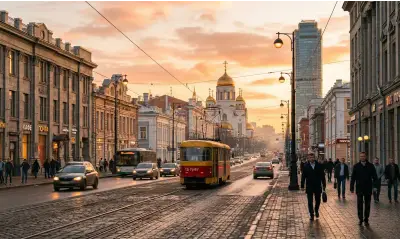
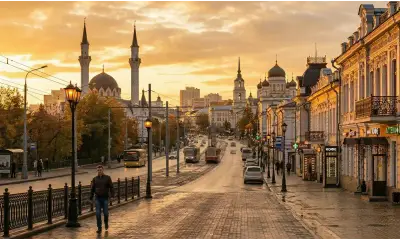
Perm is a mid-sized industrial city on the Volga's tributary, the Kama River, about 1,400 kilometers east of Moscow. It has roughly 1.3 million people and functions as a regional hub for the Urals, with manufacturing, oil refining, and cultural institutions as economic anchors. Winters are severe, dropping to minus 15 Celsius regularly. The city center has Soviet-era architecture mixed with newer commercial districts. Most residents are Russian speakers; English proficiency is limited outside tourism zones. Daily life revolves around work, family, and seasonal activities. The cultural scene includes theater and museums. Public transport relies on buses, trams, and trolleybuses. Most expats work for international companies or are remote workers.
💡 Local Insights
Perm · 2026
Perm's cost of living sits well below major European cities because it is a regional Russian city without significant expat infrastructure or foreign investment pressure. Housing costs around $406 per month, with one-bedroom apartments in central areas renting for $350 to $500, while peripheral neighborhoods drop to $300 to $400. Groceries run $175 monthly if you shop at local markets and buy seasonal produce; imported Western goods cost significantly more. Local wages are low (average salaries $400 to $600 monthly), so expats with foreign income find substantial purchasing power. Transport is cheap: a monthly transit pass costs around $12. Restaurants cater mainly to Russian tastes and budgets; eating out regularly adds $150 to $250 monthly. Utilities are subsidized for residents but can surprise newcomers in winter. The main cost risk is isolation: international flights to Moscow run $80 to $150, and visa requirements tie access to work permits. Expats report that finding quality housing or reliable services requires Russian language skills and local networks.
Frequently Asked Questions
How much does it cost to live in Perm per month?
A moderate lifestyle in Perm costs around $950 per month. This breaks down to approximately $406 for housing (rent), $175 for groceries, $12 for public transit, and $357 for utilities, dining out, and miscellaneous expenses. A budget tier lifestyle runs $570 monthly, mainly by reducing housing to $250-$300 and cooking exclusively at home. A comfortable lifestyle with dining out, travel within the city, and more spacious housing costs $1,473 per month. These figures assume you speak basic Russian and avoid expat-premium pricing.
What is the average rent in Perm?
Average rent in Perm is approximately $406 per month, based on typical one-bedroom apartments. A one-bedroom in the city center rents for $380 to $500, while similar apartments in outer neighborhoods rent for $280 to $380. Two-bedroom apartments in central areas run $500 to $700; peripheral locations $400 to $550. Furnished apartments cost 10-20% more than unfurnished. Shared apartments or rooms rent for $150 to $250. Prices are lower than comparable Russian cities of Perm's size because demand from expats is limited and local incomes are modest. Most leases require three to six months' deposit upfront.
Is Perm cheap to live in for expats?
Yes, Perm is genuinely affordable compared to Western Europe or major Russian cities like Moscow and St. Petersburg. An expat earning a modest international salary can live comfortably on $1,000 to $1,500 monthly. However, Perm is not cheap in the sense of being a popular expat destination with established support networks. You will pay premiums for English-language services, international goods, and professional expatriate housing. The real cost advantage comes from low local prices for rent, food, and transport if you live like a local resident. Visa complexity and limited English proficiency create hidden costs in time and frustration. It works best for remote workers or people sent by employers with relocation support.
How much does food cost per month in Perm?
Groceries cost approximately $175 per month if you shop at local markets and supermarkets. Bread runs $0.50-$1, milk $1.50-$2.50 per liter, chicken $4-$6 per kilogram, and potatoes $0.40-$0.70 per kilogram. Seasonal produce (cabbage, beets, carrots) is cheaper in fall and winter. Imported Western foods cost 2-3 times local prices. Eating out at local cafes costs $3 to $7 per meal; restaurant meals are $10 to $20. A month of eating out regularly adds $200-$300. Alcohol is cheap: beer $1-$2, vodka $5-$8 per bottle. Tap water is drinkable but many residents boil or filter it.
What salary do you need to live comfortably in Perm?
A comfortable lifestyle in Perm costs approximately $1,473 per month, which translates to a gross annual income of around $17,700. This covers spacious housing ($500-$600), regular dining out, cultural activities, and occasional travel. If you are supporting dependents or want a Western-standard apartment with modern amenities, budget $1,800-$2,200 monthly. Remote workers earning USD or EUR have significant advantages; a $2,500 monthly income places you solidly in the upper-middle class. Local salaries average $400-$600 monthly, so expat wages are dramatically higher. Many expats work remotely for foreign employers or are posted by multinationals with expatriate packages.
How does the cost of living in Perm compare to other places?
Perm sits comfortably in the middle tier for Eastern European cities. A moderate lifestyle costs $950 per month here, with housing running $406 monthly. That puts it very close to Skopje, which also costs around $1,000 for a moderate budget, though Skopje's housing is slightly cheaper at $365. If you're coming from Western Europe, Perm is notably less expensive. Bucharest, for comparison, runs $1,350 monthly and has housing at $578. On the other end, Kharkiv is genuinely affordable at $650 monthly with housing at just $205. So Perm offers reasonable pricing without being rock-bottom. You'll find it a sensible choice for someone wanting Eastern European costs without sacrificing urban amenities.
Yes, you can live in Perm on $570 per month, but it requires discipline. Budget $250-$300 for housing (small apartment or shared space in outer neighborhoods), $175 for groceries (cooking all meals at home, shopping markets), $12 for transit, and $33-$70 for utilities and essentials. You will not eat out, travel extensively, or buy imported goods. This budget works for long-term residents who speak Russian and have local knowledge. It is tight for expats unfamiliar with the city, who may need temporary housing, translations, or emergency services. Many expats manage $700-$800 by reducing housing costs to $300 and adding modest dining out. The budget tier is livable but leaves no margin for unexpected costs.