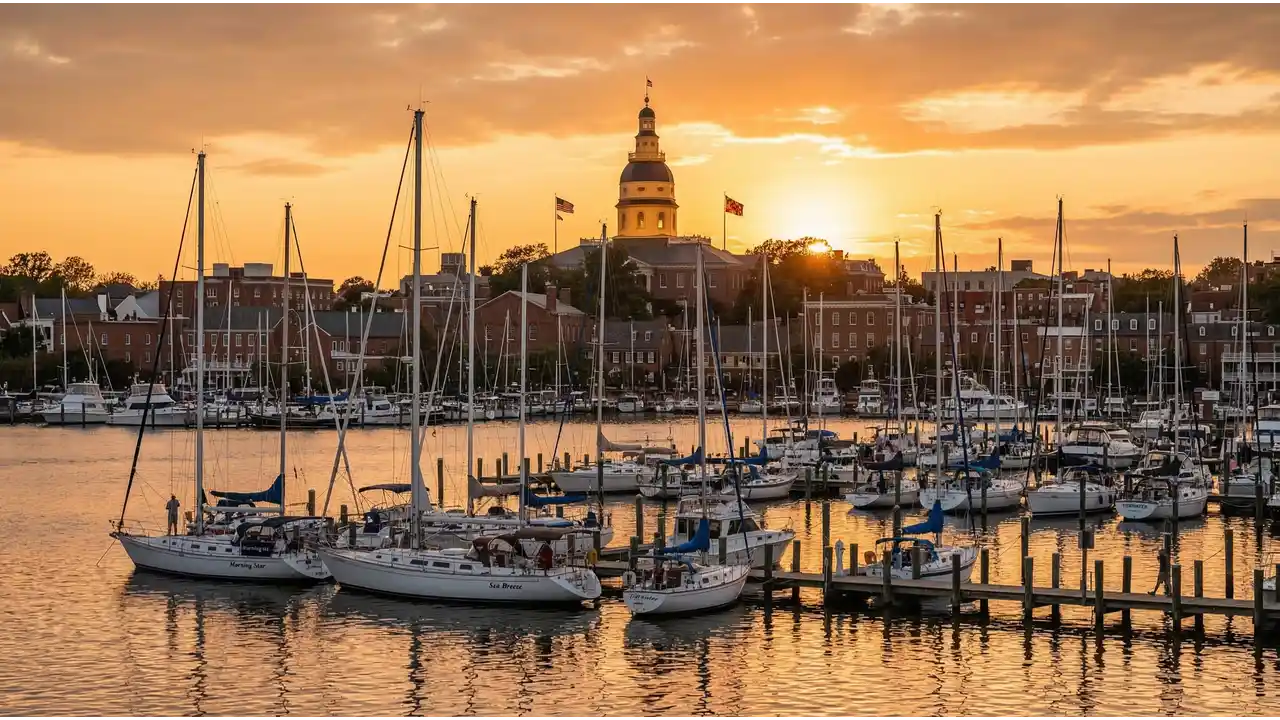
Maryland is a mid-Atlantic state shaped by its proximity to Washington DC and Baltimore. The population is diverse, with strong African American communities, significant immigrant populations, and a large federal workforce. Daily life varies sharply between urban Baltimore and DC suburbs (dense, transit-accessible, expensive) and rural Eastern Shore or western mountain towns (quiet, car-dependent, cheaper). Summers are humid and hot; winters are mild but wet. The state has strong universities, healthcare institutions, and biotechnology sectors. Most residents drive, though Baltimore and parts of Montgomery and Prince George's counties have public transit. Cost varies dramatically by location and proximity to DC.
💡 Local Insights
Maryland · 2026
Maryland's cost structure is heavily influenced by its DC suburbs, which pull the state average up. Housing averages $1,712 per month, but this masks wide regional variation. Suburban Baltimore and Montgomery County near DC command $1,900 to $2,200 for a one-bedroom apartment, while smaller cities like Frederick or Hagerstown run $1,200 to $1,500. Groceries average $545 monthly, in line with national mid-Atlantic pricing. Transportation costs depend entirely on location. Suburban residents need a car (insurance, gas, maintenance add $600 to $900 monthly); transit-accessible Baltimore or Silver Spring neighborhoods can reduce this. Expats often pay more initially for furnished rentals or short-term leases, sometimes 15 to 25 percent above unfurnished market rates. Local wages in tech and federal contracting are competitive, which keeps rents higher than cost-of-living indices in other mid-Atlantic states. Food prices are stable; dining out ranges from $12 to $16 for casual meals to $25 to $45 for restaurant entries. Utilities (electricity, gas, water) run $120 to $180 monthly depending on season and efficiency.
Frequently Asked Questions
How much does it cost to live in Maryland per month?
A moderate lifestyle in Maryland costs $3,400 per month. This breaks down roughly as: housing $1,712, groceries $545, utilities and household goods $400, transportation $450, and dining and entertainment $295. A bare-bones budget runs around $2,040 monthly (tight housing, minimal discretionary spending), while a comfortable lifestyle costs $5,270 (better neighborhood, dining out, recreational activities). The actual figure depends heavily on whether you live in a DC suburb, Baltimore proper, or a smaller town. Expats and people relocating should budget toward the moderate or comfortable tier for the first few months until they find permanent housing.
What is the average rent in Maryland?
Average rent in Maryland is approximately $1,712 per month for a one-bedroom apartment in a moderate neighborhood. This figure varies significantly by region. In Montgomery County suburbs near DC (Bethesda, Silver Spring), expect $1,900 to $2,200 for a one-bedroom. Baltimore City neighborhoods like Canton or Federal Hill range from $1,400 to $1,800. Smaller cities like Annapolis, Frederick, or Salisbury run $1,200 to $1,500. Rural areas and small towns in Western Maryland or the Eastern Shore can be found for $900 to $1,200. Two-bedroom apartments typically add $300 to $500 to these figures. Furnished or corporate housing for short-term rental costs 15 to 25 percent more. Landlord costs and Maryland's tenant protections (right to habitable space, notice requirements) are factored into these rates.
Is Maryland cheap to live in for expats?
Maryland is moderately priced for expats, but not cheap. The DC suburban corridor (Montgomery, Prince George's, Howard counties) ranks among the more expensive regions in the United States, with rent and living costs comparable to Boston or Philadelphia. Baltimore and smaller cities offer better value. For expats accustomed to high-cost cities (London, New York, San Francisco, Toronto), Maryland feels affordable. For those from lower-cost regions (rural Mexico, parts of Eastern Europe, Southeast Asia), it will feel expensive. Expats should expect to pay premiums on short-term or furnished housing. The state has no local income tax, which helps offset other costs. Strong international communities exist in Montgomery County and parts of Baltimore, which can ease relocation but also push rents higher in those neighborhoods.
How much does food cost per month in Maryland?
Groceries average $545 per month for one person on a moderate budget. A weekly shop for staples (eggs $3 to $4 per dozen, milk $3.50 to $4.50 per gallon, chicken breast $6 to $8 per pound, fresh vegetables $2 to $4 per item) totals around $125 to $140. Eating out is common in Maryland, particularly in Baltimore and DC suburbs. Casual dining (pizza, Chinese, casual American) costs $12 to $16 per meal. Mid-range restaurants run $18 to $30 per entree. Seafood (Maryland's specialty, especially crab) is pricier: a crab cake sandwich at a local spot runs $14 to $22. Coffee runs $3 to $5. Alcohol at bars and restaurants adds significantly. For a moderate budget, allocate roughly $280 for groceries and $265 for dining out monthly.
What salary do you need to live comfortably in Maryland?
A comfortable lifestyle in Maryland requires approximately $5,270 per month, or about $63,240 per year before taxes. This allows for a nicer one or two-bedroom apartment ($1,900 to $2,200), regular dining out, a car payment or reliable used car, recreational activities, and moderate savings. In the DC suburbs, you should aim for $75,000 to $90,000 annually to live without financial stress. Baltimore and smaller cities can be managed on $55,000 to $70,000. Federal employees and tech workers in Maryland often earn $60,000 to $120,000 depending on role and experience. For couples or families with dual incomes, the threshold is lower per person. If you receive remote work income from a lower cost-of-living region, $3,400 to $4,000 monthly is livable, though housing choices will be limited in prime neighborhoods.
How does the cost of living in Maryland compare to other places?
Maryland's moderate lifestyle costs $3,400 per month, which is slightly higher than the United States average of $3,275. Housing makes up the difference: a moderate tier apartment in Maryland runs $1,712 monthly, compared to $1,669 across the United States. You'll pay noticeably more than in Alabama, where a moderate lifestyle costs $2,400 monthly and housing averages $881. However, Maryland remains significantly cheaper than Hawaii, where the same lifestyle reaches $4,125 monthly with housing at $1,881. Maryland's position reflects its location in the Mid-Atlantic, where costs track close to the national average but lean toward the higher end. For someone relocating from the deep South, expect a real increase. For someone coming from Hawaii or major coastal metros, you'll find relief.
Yes, but with tight constraints. The $2,040 budget tier requires careful choices. Housing must be $1,000 to $1,200 (studio or one-bedroom in a less central area, possibly with roommate, or a small town). Groceries must be disciplined at roughly $300 to $350 monthly (mostly home cooking, minimal dining out). Utilities, phone, and internet run $100 to $140. Transportation costs need to be near zero (walk, bike, bus) or very low (used car paid off, minimal gas). Entertainment and discretionary spending are minimal. This budget works in Frederick, Hagerstown, Salisbury, or rural areas, or in Baltimore with roommates. In DC suburbs, $2,040 is below sustainable levels unless you have housing support or very low transport costs. Expats should not plan on this budget for the first 6 to 12 months; initial setup costs and furnished housing typically exceed it. It is possible long-term only with intentional frugality and location flexibility.