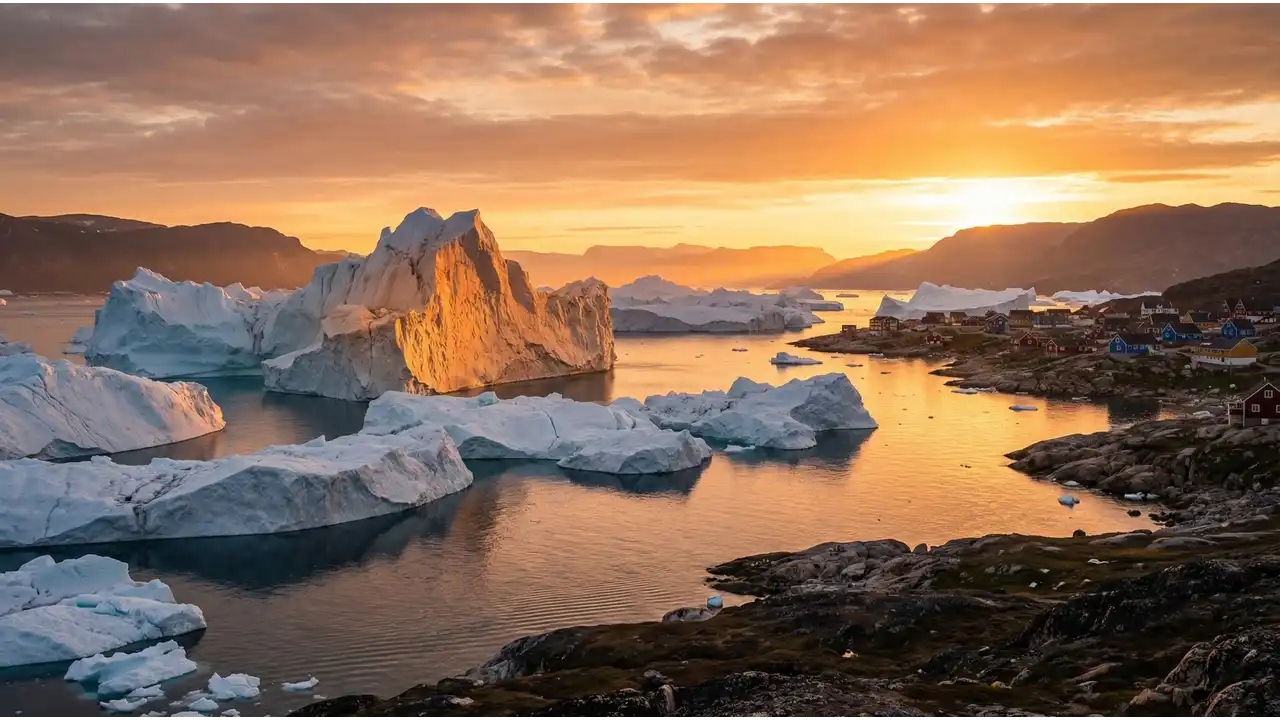
Greenland is a self-governing territory within Denmark covering a vast Arctic island with around 57,000 people, most living in small coastal settlements. Nuuk, the capital, has about 19,000 residents and serves as the administrative and commercial hub. Daily life revolves around fishing, hunting, and government employment. Winters run from October to April with minimal daylight. Summers offer the midnight sun. Most of the island is ice sheet and uninhabitable. Infrastructure is limited: no roads connect towns, so travel happens by boat, helicopter, or small plane. The local language is Greenlandic, though Danish and English are widely spoken among younger residents and in business.
💡 Local Insights
Greenland · 2026
Greenland's cost of living reflects its Arctic location and supply chain realities. Everything imported comes by ship during the brief ice-free season or by expensive air cargo, making groceries the most volatile cost category. Local fish and game are cheaper if you have hunting or fishing access. Housing in Nuuk runs $1,540 per month on average for a moderate one-bedroom apartment, though options are limited and turnover slow. Outside the capital, housing is somewhat cheaper but availability is extremely restricted. Food (groceries) averages $382 monthly, but eating out is expensive; a restaurant meal costs $20-35 per person. Heating costs are substantial in winter. The Greenlandic government subsidizes utilities heavily, keeping some costs lower than comparable Arctic regions. Transportation within towns is walkable or by local bus (Nuuk has limited service). No cars are common in smaller settlements. Many expats find the high cost of fresh produce, limited rental stock, and isolation the biggest real barriers. Employment opportunities exist mainly in government, fishing, tourism, and education. A moderate lifestyle costs $2,725 per month.
Frequently Asked Questions
How much does it cost to live in Greenland per month?
A moderate lifestyle in Greenland costs $2,725 per month. This breaks down to roughly $1,540 for housing, $382 for groceries, and the remainder for utilities, transport, dining out, and other expenses. On a tight budget, $1,635 monthly is possible if you live outside Nuuk, cook all meals, and accept minimal recreation spending. For comfort and frequent restaurant meals or travel, expect $4,224 per month. These figures assume you have stable housing; initial setup costs for deposits and furniture are separate.
What is the average rent in Greenland?
Average rent in Greenland is $1,540 per month for a one-bedroom apartment in Nuuk. A two-bedroom runs $1,800-2,100 per month. Outside the capital, rents are lower at $900-1,300 monthly, but availability is extremely limited and waiting lists are common. Most rentals are unfurnished. Landlords often require deposits equal to two or three months' rent plus references. The rental market is tight; expats should expect to search for months. Government housing assistance exists for residents, but eligibility criteria favor Greenlandic citizens. Utilities (heating, water, electricity) add $200-300 monthly in winter.
Is Greenland cheap to live in for expats?
Greenland is not cheap for expats. At $2,725 per month for a moderate lifestyle, it ranks among the costliest places globally, comparable to Copenhagen or Reykjavik. Housing and fresh food dominate expenses. The appeal is employment opportunity and salary levels, which are higher than in Denmark. Most expats arrive on work contracts where employers offset housing or provide accommodation. Without employer support, Greenland is difficult to afford on an average global salary. Expats relocating independently should budget $4,000+ monthly for stability and comfort. The isolation and supply constraints make bargains rare.
How much does food cost per month in Greenland?
Groceries average $382 per month for a budget-conscious household. Imported goods are expensive: milk runs $2.50 per liter, cheese $15-20 per 500g, and a head of lettuce $4-6. Local fish and seafood are cheaper at $8-15 per pound if bought fresh from markets. Meat is pricier than Denmark. Bread is $3-4 per loaf. Eating out is costly: lunch at a casual cafe is $18-25, dinner at a mid-range restaurant $35-50 per person. Alcohol is expensive; a beer costs $8-10 at bars. Shopping is centralized in Nuuk; smaller towns have limited selection and higher prices.
What salary do you need to live comfortably in Greenland?
A comfortable lifestyle in Greenland costs $4,224 per month, suggesting a gross income of $60,000-65,000 annually to account for taxes. This allows restaurant dining, travel within Greenland, heating comfort, and recreation. Government and fishing sector jobs typically pay $50,000-75,000 annually. Teachers and skilled workers earn similar ranges. Most expats arrive with employer-subsidized housing, which improves comfort significantly. Without housing support, you need $65,000+ gross. Danish social benefits and subsidies (childcare, education, healthcare) apply to residents, reducing out-of-pocket expenses for families. Local purchasing power is higher than salary alone suggests due to these supports.
How does the cost of living in Greenland compare to other places?
Greenland sits in the upper-middle range globally. A moderate lifestyle in Greenland costs $2,725 per month, with housing at $1,540 per month. That puts it slightly above the United Kingdom, where a moderate lifestyle runs $2,625 monthly and housing costs $1,316. Mexico is substantially cheaper, with a moderate lifestyle at $1,600 per month and housing at $730. Switzerland is notably dearer at $3,825 for a moderate lifestyle and $2,112 for housing. The gap reflects Greenland's reliance on imports, limited housing stock, and high utility costs in a subarctic climate. If you're relocating from North America or Western Europe, expect costs broadly comparable to or slightly higher than major English-speaking cities, though specific neighborhoods and lifestyle choices will move your actual expenses up or down significantly.
Yes, but with significant restrictions. $1,635 is the tight budget tier. This requires living outside Nuuk (smaller towns, lower rent), cooking all meals from groceries, no restaurant dining, minimal recreation, and accepting housing that may be basic. You would spend roughly $1,000-1,200 on rent outside the capital, leaving $400-600 for food, utilities, and transport. No margin for emergencies or travel. This budget works if you have employer housing support or a subsidized government residence. Families cannot live on this figure. Single professionals with minimal lifestyle costs and stable employment might manage, but it requires discipline and local connections for informal support (hunting, fishing, community sharing).