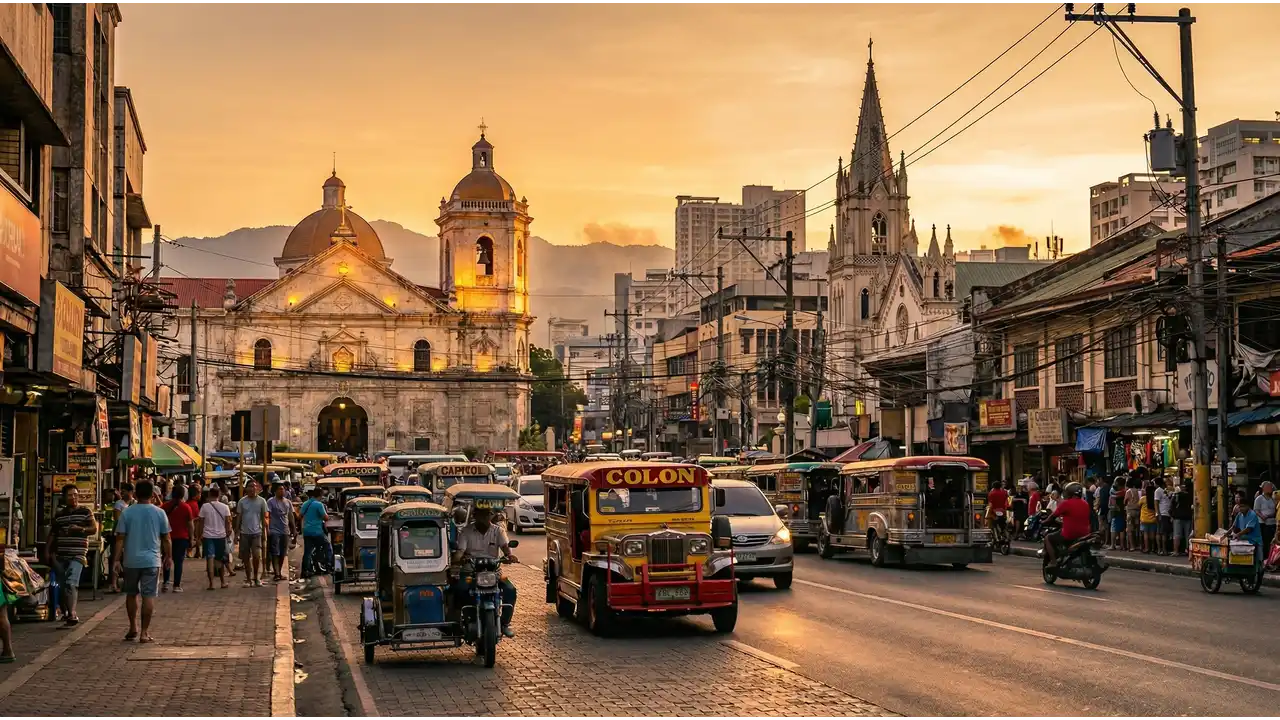
Cebu is the Philippines' second-largest city and the commercial hub of the Visayas region. It sits on a long, narrow island with a tropical climate, hot and humid year-round with a rainy season from June to November. The city has a population of around 1.6 million in the metro area, mixing Filipino families, overseas workers, and an growing expat community. Daily life centers on commercial districts like IT Park and Ayala, residential areas in Banilad and Lahug, and older neighborhoods near the waterfront. Traffic is heavy during rush hours. English is widely spoken. The city has hospitals, shopping malls, restaurants, and services geared toward both local and expat needs.
💡 Local Insights
Cebu · 2026
Cebu's moderate cost of $1,050/month reflects mid-range choices: a furnished one-bedroom apartment in IT Park or Banilad around $500-550, groceries bought at local markets and supermarkets, and regular use of taxis or ride-hailing. Housing runs $488/month on average, covering everything from $350 studio units in older neighborhoods to $700+ for newer condos with amenities. Groceries from SM City or local markets cost around $181/month if you cook at home and buy local produce, rice, and proteins. Eating out regularly (restaurant meals $3-8) will push costs higher. Transportation is cheap: taxi rides under $2, Grab (ride-hailing) rides $1-4, and jeepneys cost under $0.50 per ride. Expats often pay slightly more for housing in expat-preferred zones and imported foods, but local rates are available if you shop where Filipinos do. Utilities (electricity, water, internet) add $40-60/month. The biggest variable is whether you rent in high-end areas (Ayala, Cebu IT Park) or residential neighborhoods further from the center.
Frequently Asked Questions
How much does it cost to live in Cebu per month?
A moderate lifestyle in Cebu costs around $1,050/month. This covers a furnished one-bedroom apartment ($488/month), groceries and basic meals ($181/month), utilities ($50), transportation ($30-40), and discretionary spending on dining out, entertainment, and activities. A budget lifestyle ($630/month) means sharing accommodations, cooking almost all meals, and using public transport exclusively. A comfortable lifestyle ($1,628/month) includes a nicer apartment, dining out regularly, gym membership, and occasional travel. Costs vary based on neighborhood choice and lifestyle habits.
What is the average rent in Cebu?
Average rent in Cebu is $488/month. One-bedroom apartments in established neighborhoods like Lahug or Talamban rent for $400-500 unfurnished, or $500-600 furnished. IT Park and Banilad (more upscale expat areas) command $600-800 for similar units. Studio apartments in older areas of South Road Properties or downtown rent for $300-350. Condominiums with amenities and security run $700-1,200. Prices depend heavily on furnishing, location relative to commercial districts, and building age. Most leases are negotiable, especially for longer commitments. Expats typically pay 20-30 percent more than local rates for the same property.
Is Cebu cheap to live in for expats?
Cebu is moderately affordable for expats, particularly those from developed countries, but not as cheap as rural Philippines or Southeast Asian budget destinations like Cambodia or Myanmar. The $1,050/month moderate budget is realistic if you live like a middle-class Filipino and avoid expat premium pricing. Housing is the main variable: renting in IT Park (expat-dense) costs more than Lahug or Talamban. Many expats come on pensions or remote salaries ($1,500-3,000/month) and find Cebu comfortable without financial strain. Food costs are low if you use local markets instead of imported goods. The trade-off is that Cebu has traffic, summer heat, and less developed infrastructure than Manila or Bangkok, but significantly lower costs.
How much does food cost per month in Cebu?
Groceries cost around $181/month if you cook at home. Local markets and supermarkets offer rice ($0.40/kg), chicken ($2.50/kg), fish ($3-5/kg), vegetables ($0.50-1.50/item), and eggs ($1.20/dozen). Imported goods at supermarkets cost 50-100 percent more. Eating out is cheap: carenderia meals (small Filipino restaurants) cost $1-2, casual restaurants $3-5, mid-range restaurants $6-10. A meal at a mall food court runs $2-4. Coffee is $0.80-1.50. Eating out daily adds $30-60/month to your budget; cooking most meals keeps food spending near the $181 baseline. Expats often spend more on imported items and dining out, pushing food costs to $250-350/month.
What salary do you need to live comfortably in Cebu?
A comfortable lifestyle in Cebu requires around $1,628/month. This allows a nice one or two-bedroom apartment, regular dining out at mid-range restaurants, gym or fitness activities, regular domestic help (housecleaner $40-60/month), occasional travel, and quality healthcare. A comfortable income for expats is typically $1,500-2,500/month, either from remote work, pension, or freelance income. Many expats live on $1,200-1,400 comfortably by choosing residential neighborhoods over premium expat zones and cooking some meals. For a family of two, budget $2,000-2,500/month for comfortable living. The Philippine Bureau of Internal Revenue does not track a formal poverty line for the metro area, but $1,628 aligns with professional middle-class living standards.
How does the cost of living in Cebu compare to other places?
Cebu sits in the middle of the global cost-of-living spectrum. A moderate lifestyle here runs $1,050 per month, with housing at $488 per month. That makes Cebu nearly identical to Hangzhou, where a moderate lifestyle costs $1,100 monthly and housing $517 monthly. If you're coming from a cheaper city, Tehran costs only $800 for a moderate lifestyle with housing at $406 per month, so Cebu will feel noticeably more expensive. By contrast, Osaka is substantially dearer at $1,450 monthly overall and $722 for housing alone. For most expats from Western cities, Cebu offers genuine savings. For those relocating from Southeast Asia or the Middle East, budget accordingly for a step up in costs.
Yes, but with significant constraints. A $630/month budget requires shared housing ($250-300/month for a room), cooking almost all meals from local markets ($150/month), no dining out, minimal entertainment, and walking or jeepney transport ($15/month). This works for budget travelers, retirees on tight pensions, or those supplemented by cheap Philippine housing arrangements. You'll have basic utilities, no gym membership, no regular paid entertainment, and limited ability to travel. Expats on this budget typically live in residential areas far from commercial centers, use local services, and adopt a local lifestyle rather than an expat one. Healthcare emergencies or unexpected costs are difficult. Most expats find $800-1,000 more realistic for stress-free living, but $630 is possible with careful spending and low expectations.