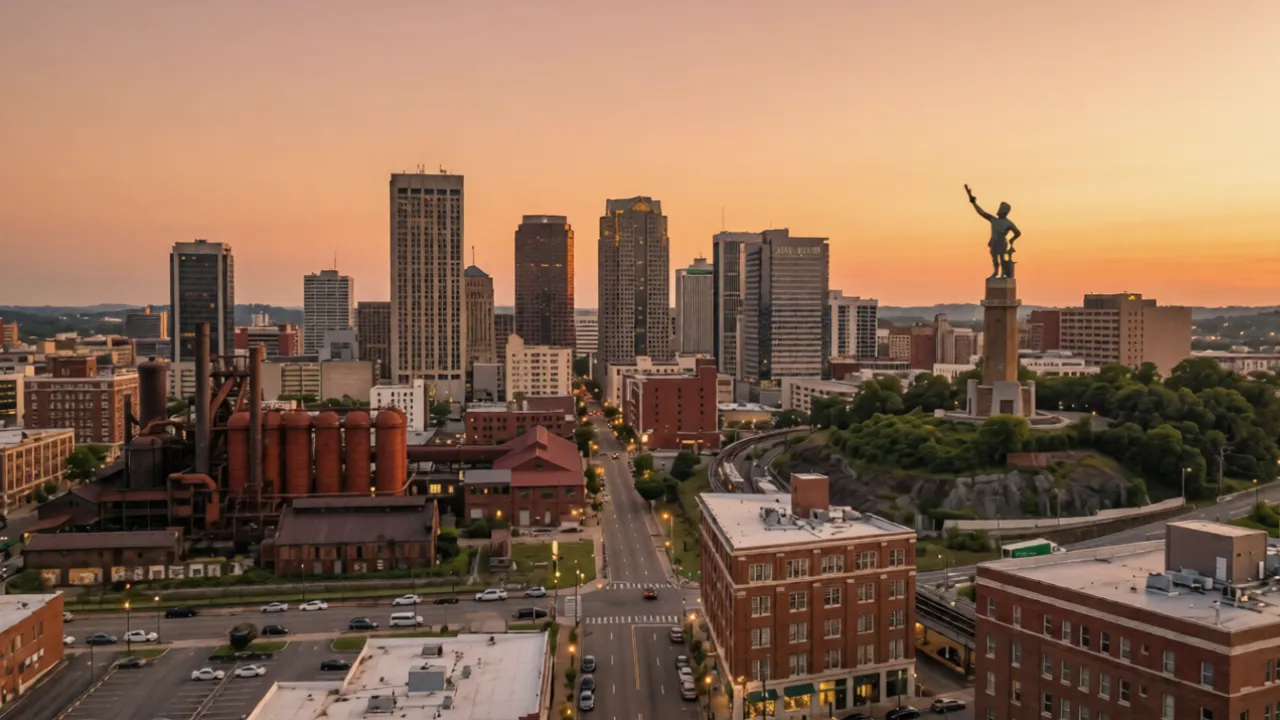
Birmingham is Alabama's largest city and a regional economic center with a population around 190,000. It sits in the Jones Valley with a humid subtropical climate (hot summers, mild winters). The city has a strong industrial and medical presence, particularly around the University of Alabama at Birmingham medical campus. Daily life revolves around car travel, though some neighborhoods like Lakeview and Forest Park have walkable blocks. The food scene centers on Southern cooking and barbecue. Weather is warm most of the year, with occasional ice storms in winter. Schools, parks, and museums anchor community activity. The city is racially diverse and historically significant, with civil rights landmarks throughout.
💡 Local Insights
Birmingham AL · 2026
Birmingham's affordability reflects its position as a secondary U.S. city with lower land costs than major metros. Housing at $1,199 per month covers one-bedroom apartments downtown or in established neighborhoods like Avondale and Five Points, though rental supply is tightest near the medical center. Groceries at $492 monthly are below the national average; major chains like Publix and Walmart anchor food costs. Transportation depends entirely on a car for most residents (no meaningful public transit), which adds to real expenses beyond the moderate $2,725 figure. Utility costs are moderate but air conditioning runs high in summer. Expats find prices comparable to other Southeastern cities like Nashville or Charlotte, but less developed than those markets. Local employment in healthcare, manufacturing, and education shapes income levels. The budget tier of $1,635 requires roommates or location trade-offs; the comfortable tier at $4,224 accounts for dining out, car ownership, and discretionary spending.
Frequently Asked Questions
How much does it cost to live in Birmingham AL per month?
A moderate lifestyle in Birmingham costs $2,725 per month. This breaks down to $1,199 for housing (rent, utilities, maintenance on a one-bedroom apartment in mid-range neighborhoods), $492 for groceries, and the remainder for transportation, dining out, entertainment, and personal care. A tight budget works at $1,635 monthly (typically shared housing and minimal discretionary spending). A comfortable lifestyle allowing dining out regularly, car ownership, and travel runs $4,224 per month. These figures reflect current cost data and assume urban or inner-ring suburban location.
What is the average rent in Birmingham AL?
Average rent is $1,199 per month for a one-bedroom apartment. In central neighborhoods like Lakeview, Five Points, and Avondale, expect $1,100 to $1,300 for a one-bedroom. Studios run $800 to $950. Two-bedroom apartments are typically $1,400 to $1,600. Prices are higher near the UAB medical center and lower in outer areas like Homewood or Mountain Brook (though those suburbs have different cost profiles). Downtown lofts start around $1,200. Most leases run 12 months; landlords typically require first month, last month, and a security deposit equal to one month's rent.
Is Birmingham AL cheap to live in for expats?
Yes, relative to most U.S. expat destinations. At $2,725 monthly for a moderate lifestyle, Birmingham is significantly cheaper than Austin, Denver, or Portland. It's comparable to or slightly cheaper than Nashville and Raleigh. Expats from Western Europe or Australia find it very affordable. The trade-off is limited public services, car dependency, and a smaller expat community. Healthcare is excellent around UAB but can be bureaucratically complex for newcomers. The city attracts expats in healthcare, tech, and education sectors. Visa sponsorship for corporate jobs exists but is not common. English speakers from Commonwealth countries find adaptation straightforward; language is not a barrier.
How much does food cost per month in Birmingham AL?
Groceries average $492 per month for one person eating basic meals at home (chicken, rice, vegetables, dairy, bread). Specifics: a pound of chicken runs $4 to $6, milk $3 to $4 per gallon, eggs $3 to $5 per dozen at major chains. Eating out varies by neighborhood: casual meals (burgers, barbecue) cost $10 to $15; sit-down restaurants $15 to $25 per entree. The city's barbecue tradition is strong and affordable (pulled pork plates $8 to $12). International groceries (Asian, Latin) are available in diverse areas but carry higher markups than mass-market chains like Walmart or Publix.
What salary do you need to live comfortably in Birmingham AL?
A comfortable lifestyle costs $4,224 per month, suggesting an annual gross income around $52,000 to $56,000 (accounting for taxes). This allows for a nicer one-bedroom or modest two-bedroom apartment, regular dining out, reliable car ownership with insurance and fuel, entertainment, and modest travel. For households, dual incomes of $35,000 to $40,000 each provide comfortable living. Median household income in Birmingham is around $42,000, so the comfortable tier requires income above median or dual earners. The tight budget of $1,635 monthly is feasible on minimum wage with roommates but leaves minimal buffer for emergencies.
How does the cost of living in Birmingham AL compare to other places?
Birmingham sits in the lower-to-middle range for US cities. A moderate lifestyle runs $2,725 monthly, with housing at $1,199 per month. That puts it slightly cheaper than Jacksonville, where a moderate lifestyle costs $2,850 with housing at $1,253 per month. Both are peer cities in terms of affordability. If you're considering a move from a major coastal hub, the difference is stark: Miami runs $3,925 monthly for a moderate lifestyle, with housing alone at $2,311 per month. Birmingham's costs are also considerably higher than Mexico City, which runs $1,925 for a moderate lifestyle. For someone relocating within the US Southeast or from abroad, Birmingham offers genuine affordability without sacrificing urban amenities.
Yes, but with significant constraints. This budget tier requires shared housing ($650 to $800 rent share), minimal groceries ($350 to $400, eating simply), no car ownership (relies on rides, transit, or walking), and nearly no discretionary spending. It's viable for students, those with stipends, or people with extremely frugal habits. The math works only if housing is subsidized (family, university, employer housing) or shared with multiple roommates. Healthcare costs and unexpected expenses rapidly break this budget. A single emergency (car repair, medical bill) forces difficult choices. This tier is realistic for short-term stays or people with significant financial reserves, but risky as a permanent living situation without supplemental income or support.